
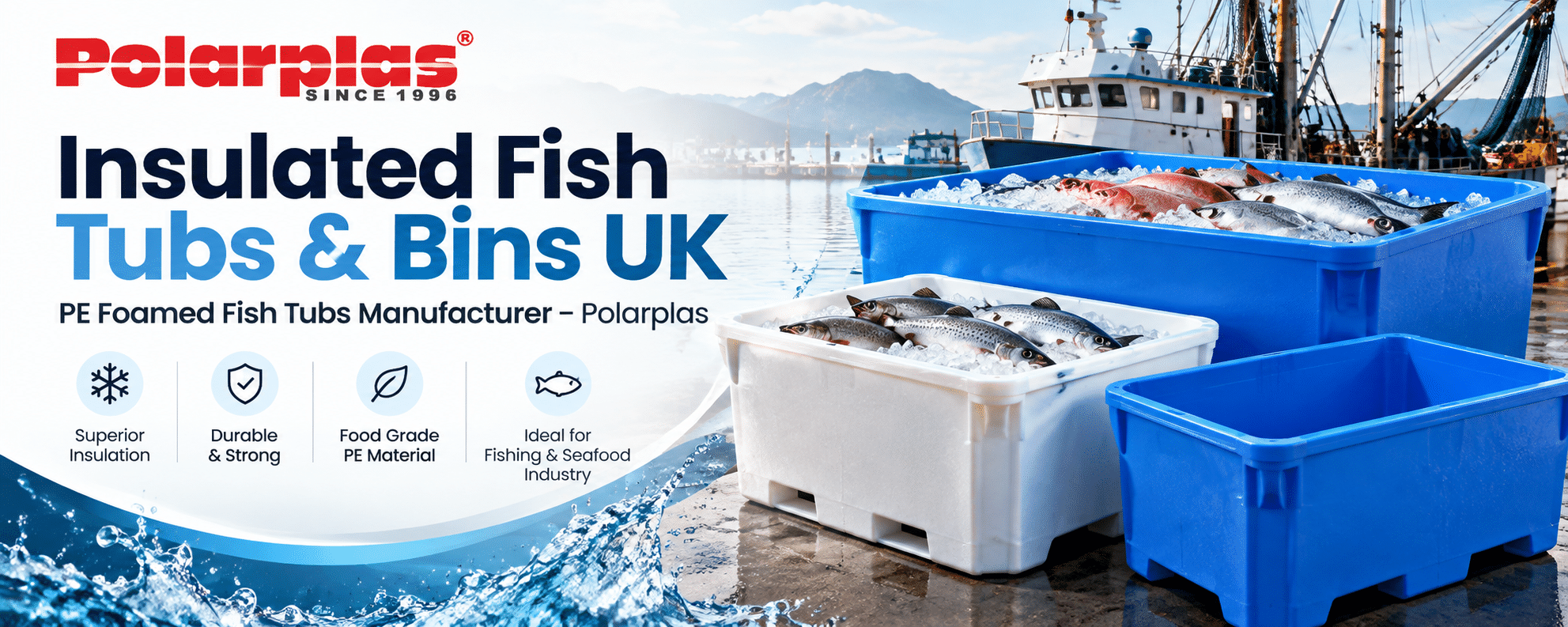
Every UK fishery, from the trawlers docking at Peterhead and Fraserburgh to the processing lines of Grimsby, Hull and Aberdeen, runs on one non-negotiable promise: the catch has to stay cold from the moment it leaves the water until it reaches the customer. That promise depends on one piece of equipment that rarely gets any credit — the insulated fish tub.
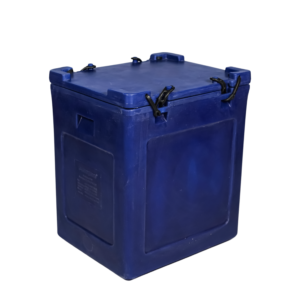
At Polarplas, we manufacture insulated fish tubs and bins using rotational moulding technology in food-grade LLDPE and HDPE, with the cavity between the double walls filled with either PE foam or PUR (polyurethane) foam. Our fish tubs, bins and totes are exported specifically for markets like the United Kingdom, where long coastlines, busy ports and strict food-safety expectations demand containers that simply do not fail.
Why Cold Chain Reliability Matters for UK Fisheries
A two-to-three-degree temperature swing can turn a premium-grade consignment into a rejected one. For a UK exporter shipping langoustine, cod, haddock, mackerel or salmon to Europe, that swing can happen inside a badly insulated tub before the truck has even left the port. This is why fishing associations, processors and cold-chain operators across the UK are increasingly moving away from generic, uninsulated containers and searching for a dependable insulated fish tub manufacturer in the UK market instead.
Unlike single-wall pallet boxes that rely purely on fast handling to limit temperature rise, a properly insulated fish tub buys processors time — time to load a vessel, time to clear customs, time to reach a distribution centre without the ice melting away and the catch losing grade.
Where UK Businesses Use Insulated Fish Tubs
- On-board catch handling on trawlers and fishing vessels
- Quayside sorting and grading at fish markets
- Cold storage and warehouse handling at processing plants
- Road and sea transport to EU seafood buyers
- Retail and wholesale seafood distribution across the UK
What Are PE Foamed Insulated Fish Tubs?
PE foamed insulated fish tubs are built with a double-wall rotationally moulded shell, with the gap between the inner and outer wall injected with closed-cell polyethylene (PE) foam. This construction method gives the tub three properties that a single-wall container cannot offer: sustained insulation, structural rigidity, and resistance to the physical knocks that happen constantly at a working port.

How PE Foam Compares to PUR Foam
Both foam types are used across our PUR foamed product range and PE foamed fish tubs and bins, and the right choice depends on how the tub will actually be used in the UK.
| Factor | PE Foam | PUR Foam |
|---|---|---|
| Insulation value | Good | Higher per cm of thickness |
| Impact resistance | Excellent | Good |
| Recyclability | Widely recyclable | Limited |
| Best suited for | Quayside handling, short-to-medium haul | Extended transport, long-duration ice retention |
Insulated Fish Tubs vs Non-Insulated Pallet Boxes: What UK Processors Actually Need
Not every UK cold-chain application needs a fully insulated container. Some UK processors use single-wall, non-insulated HDPE pallet boxes for high-speed chilling before the catch even reaches an insulated stage — the lack of insulation lets the product cool faster and removes a potential site for inter-wall contamination. This works well when the entire journey happens inside a controlled, chilled environment.
The moment any part of the journey moves outside that controlled environment — a quayside wait, a road journey, an export shipment to the EU — an insulated fish tub becomes essential. The double wall and foam core actively slow down heat transfer instead of simply relying on ambient chilling, which is why most UK exporters use insulated tubs for anything leaving the immediate processing facility.
Quick Decision Guide for UK Buyers
Choose a non-insulated pallet box if: the product stays inside a refrigerated facility for its entire journey and rapid cooling is the priority.
Choose an insulated fish tub if: the catch travels by road, sea, or spends time at ambient temperature — including exports to Europe.
Fish Tub Sizes for the UK Market
Polarplas manufactures insulated fish tubs, bins and totes across a wide capacity range so that everyone from a small independent processor to a large export operation can find the right fit. Choosing the correct size affects not just cost, but also stacking efficiency, forklift handling and how much ice-to-catch ratio a UK business can maintain during transport.
| Capacity | Typical UK Use Case |
|---|---|
| 70L – 100L | Small processors, retail delivery, market stalls |
| 150L – 250L | Mid-size wholesalers, quayside grading |
| 400L – 620L | Trawler-side handling, cold storage warehouses |
| 900L – 1250L | Large-scale export operations and bulk logistics |

Built for UK Coastal Conditions
Polarplas products are engineered to perform across extreme environments — from the harsh heat of sub-Saharan regions to the freezing cold of North America — which means the same rotationally moulded, double-wall insulated design is more than capable of handling the wet, cold, salt-heavy conditions of UK ports like Peterhead, Aberdeen, Grimsby and Hull. The LLDPE and HDPE shell resists cracking in low temperatures, while the foam core keeps performing even after years of repeated quayside use.
Beyond Fish Tubs: Related Cold Chain Products
Insulated fish tubs rarely work in isolation. Most UK processors and logistics operators pair them with other insulated equipment across the cold chain. Explore our related ranges:
Related Polarplas Product Ranges
- Insulated Coolers / Ice Boxes — for retail, delivery and smaller-scale transport
- Insulated Round Tubs — for dairy, meat and general food handling
- Hygienic Pallets — for food-safe warehouse and processing floor handling
- Refrigeration Products — deep freezers and transport freezers
- Custom Moulded Products — bespoke tubs built to your specification
Why UK Fisheries Choose Polarplas
What Sets Our Insulated Fish Tubs Apart
- Manufacturing since 1996, exclusively for export markets
- Rotational moulding in food-grade LLDPE and HDPE
- Choice of PE or PUR foam insulation depending on your route and duration
- Capacity range from 70L to 1250L
- Custom moulding available for fishery-specific dimensions and branding
- Engineered to withstand extreme temperature ranges, from sub-Saharan heat to North American cold
For general food safety benchmarks that UK seafood processors are typically expected to meet, the Seafish UK industry authority is a useful independent reference point when evaluating cold-chain equipment suppliers.
Frequently Asked Questions
What sizes do insulated fish tubs come in for the UK market?
They range from 70 litres for small-scale processors up to 1250 litres for large industrial fisheries and cold-chain logistics operators across the UK.
What is the difference between PE foamed and PUR foamed insulated fish tubs?
PE foam offers excellent impact resistance and is widely recyclable, making it suitable for rough quayside handling. PUR foam offers a higher insulation value per centimetre, which helps keep ice colder for longer during extended transport to Europe.
Are Polarplas insulated fish tubs food-safe and compliant with UK standards?
Yes — they are rotationally moulded in food-grade LLDPE and HDPE, designed to meet the hygiene and food-contact expectations of UK seafood processors, wholesalers and exporters.
Do insulated fish tubs work for both fishing vessels and cold storage warehouses?
Yes. The same double-wall insulated design is used on trawlers for on-board catch handling, at quayside processing units, and in cold storage and logistics warehouses for longer-duration storage.
Can insulated fish tubs be customised for a specific UK fishery or processor?
Yes. Polarplas offers custom moulded insulated tubs and bins matched to your required dimensions, wall thickness, colour and branding.
Looking for Insulated Fish Tubs for Your UK Operation?
Get a quote for PE or PUR foamed insulated fish tubs and bins, custom sized for your fishery, processor or cold-chain business.
European Branch — Polarplas UK Ltd
Suite 264, Unit 3A, 34-35 Hatton Garden Holborn, London, United Kingdom EC1N 8DX
Contact: +44 79 1552 1129
