
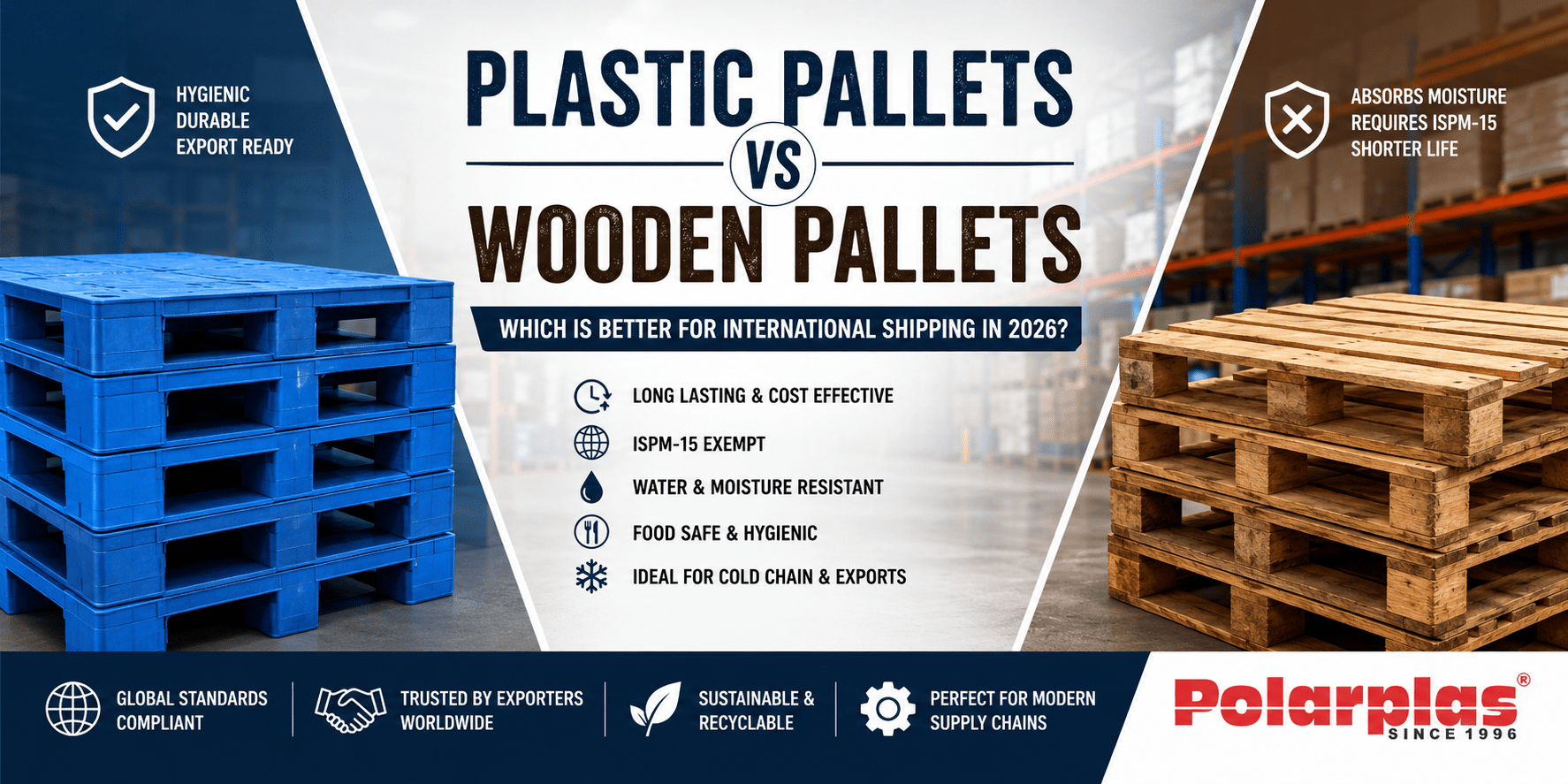
Plastic Pallets vs Wooden Pallets: Which Is Better for International Shipping in 2026?
Reading Time: 10 Minutes |
Updated: July 2026 |
Category: Export Logistics
Plastic Pallets vs Wooden Pallets is one of the most searched comparisons among manufacturers, exporters and logistics professionals looking for reliable material handling solutions. As international trade continues to grow, businesses across North America, Europe, Australia and the Middle East are focusing on packaging systems that improve efficiency, reduce shipping costs and comply with global export regulations.Choosing the right pallet is no longer just about transportation—it directly affects product safety, warehouse operations, food hygiene, cold chain performance and overall supply chain efficiency. While wooden pallets have been the traditional choice for decades, plastic pallets are rapidly becoming the preferred option for international shipping because of their durability, moisture resistance and long service life.
In this comprehensive guide, we compare Plastic Pallets vs Wooden Pallets based on export compliance, cost, hygiene, sustainability, warehouse automation and long-term return on investment. Whether you are a food manufacturer, pharmaceutical company, warehouse operator or global exporter, this guide will help you choose the right pallet for your business.
Plastic Pallets vs Wooden Pallets: Key Differences
- Why Pallets Matter in International Shipping
- What are Plastic Pallets?
- What are Wooden Pallets?
- Global Shift Towards Plastic Pallets
- Comparison Overview
- Which Industries Prefer Plastic Pallets?
- Conclusion
- Frequently Asked Questions
Why Pallets Matter in International Shipping
Every international shipment relies on proper material handling. Whether products are transported by sea, air or road, pallets form the foundation of the supply chain. They protect goods during loading, unloading, warehousing and container transportation.
A damaged pallet can lead to damaged products, delayed deliveries and unexpected financial losses.
For exporters serving food processing companies, pharmaceutical manufacturers, automotive suppliers or retail distribution centres, pallet quality directly affects customer satisfaction.
Today, global buyers evaluate not only the product but also how safely and efficiently it reaches their warehouse.
Because of this, choosing the right pallet has become an important business decision rather than a simple packaging choice.

What Are Plastic Pallets?
Plastic pallets are reusable material-handling platforms manufactured using high-quality polymers such as HDPE (High Density Polyethylene) and PP (Polypropylene).
Unlike traditional wooden pallets, plastic pallets are designed to withstand moisture, chemicals, heavy loads and repeated transportation cycles.
Their smooth surface makes cleaning easier, making them highly suitable for industries where hygiene is essential.
Food processing companies, seafood exporters, pharmaceutical manufacturers, dairy businesses and beverage companies increasingly prefer plastic pallets because they reduce contamination risks while improving operational efficiency.
Modern plastic pallets are available in different load capacities, nesting configurations and rackable designs, allowing businesses to optimize warehouse storage and transportation costs.
Many global manufacturers also choose plastic pallets because they maintain consistent dimensions throughout their lifespan, making them compatible with automated warehouses and conveyor systems.
What Are Wooden Pallets?
Wooden pallets have been the backbone of global logistics for decades.
They are widely available and generally cost less than plastic pallets during the initial purchase.
For many industries, especially domestic transportation, wooden pallets continue to be a practical solution.
However, international trade introduces several challenges.
Wood absorbs moisture, may develop mould, can splinter over time and is susceptible to insect infestation.
Because of these risks, many countries require wooden pallets to comply with ISPM-15 regulations before entering international markets.
Heat treatment and fumigation increase operational complexity and add additional costs for exporters.
Repeated handling with forklifts can also reduce the lifespan of wooden pallets, requiring frequent repairs or replacements.
Why International Buyers Are Rapidly Switching to Plastic Pallets
The global logistics industry is changing rapidly.
Automation, food safety regulations and sustainability goals are encouraging businesses to adopt more reliable packaging solutions.
Plastic pallets address many challenges associated with wooden pallets.
They are water-resistant, corrosion-free, easy to sanitize and suitable for cold chain logistics.
Unlike timber pallets, they do not produce splinters that could damage packaging or create safety hazards for warehouse workers.
Many multinational companies have already standardized plastic pallets across their distribution networks because they offer predictable performance and longer service life.
Although the upfront investment is higher, businesses often recover the cost through lower maintenance, fewer replacements and reduced product damage.
For exporters targeting premium international buyers, plastic pallets are increasingly viewed as a long-term investment rather than an operational expense.
For manufacturers like PolarPlas, this shift presents an excellent opportunity.
By supplying high-quality plastic pallets designed for international industries, manufacturers can meet the growing demand for hygienic, durable and export-ready material handling solutions across multiple global markets.
Plastic Pallets vs Wooden Pallets: A Detailed Comparison
Choosing between plastic pallets and wooden pallets is not simply about the purchase price. Modern supply chains evaluate pallets based on durability, hygiene, compliance, handling efficiency, sustainability and long-term operating costs. While wooden pallets have traditionally been used across industries, plastic pallets are increasingly becoming the preferred option for international logistics because they solve many challenges associated with global transportation. Businesses exporting to Europe, North America, Australia and the Middle East often prioritize packaging solutions that reduce product damage, comply with import regulations and improve warehouse efficiency. Plastic pallets deliver these advantages consistently, making them an ideal investment for companies focused on long-term growth.
| Feature | Plastic Pallets | Wooden Pallets |
|---|---|---|
| International Export | Excellent | Requires treatment |
| ISPM-15 | Not Required | Required |
| Moisture Resistance | Excellent | Poor |
| Food Safety | Excellent | Moderate |
| Life Span | 8-10 Years* | 2-5 Years* |
| Maintenance | Very Low | High |
| Automation Compatible | Yes | Limited |
| Cold Storage | Excellent | Limited |
*Actual service life depends on load conditions, usage frequency and operating environment.
Why ISPM-15 Matters in Global Trade

One of the biggest advantages of plastic pallets is that they are exempt from ISPM-15 regulations. ISPM-15 is an international standard developed to prevent the spread of insects and plant diseases through wooden packaging materials. Exporters using wooden pallets often need heat treatment and official markings before goods can enter many countries. This process increases operational complexity, documentation requirements and overall logistics costs.
Plastic pallets eliminate these concerns. Since they are manufactured from polymer materials rather than natural wood, they do not require fumigation or heat treatment. This simplifies export documentation and reduces delays at customs checkpoints. Businesses that ship products regularly benefit from faster logistics operations and fewer compliance-related issues.
Food Safety & Hygiene Standards

Food manufacturers and pharmaceutical companies must maintain strict hygiene throughout the supply chain. Plastic pallets provide a non-porous surface that does not absorb moisture, chemicals or food residue. They are easy to wash and sanitize, making them ideal for industries where cleanliness is critical. Unlike wooden pallets, they do not splinter or release dust particles that may contaminate packaged products.
Many global food manufacturers prefer food-grade plastic pallets because they help support high hygiene standards in processing facilities, cold storage warehouses and export distribution centres. Their smooth construction also minimizes bacterial growth compared to damaged or moisture-exposed wooden pallets.
Initial Cost vs Total Cost of Ownership

A common misconception is that plastic pallets are expensive. While their initial purchase price is generally higher than wooden pallets, evaluating only the upfront cost provides an incomplete picture. Businesses should instead calculate the total cost of ownership over several years.
Plastic pallets usually last much longer, require minimal maintenance, reduce product damage, eliminate repair expenses and lower replacement frequency. Their consistent dimensions also improve warehouse automation and reduce operational downtime. For exporters handling thousands of shipments every year, these advantages often translate into significant long-term savings.
Expert Insight
Companies focused on international exports should evaluate pallets as a long-term logistics investment rather than a one-time packaging purchase. Choosing durable, hygienic and export-ready plastic pallets can improve supply chain efficiency while enhancing brand reputation among global buyers.
Explore PolarPlas’ range of plastic pallets and industrial storage solutions designed for food processing, logistics, cold chain and export applications.
Industries That Prefer Plastic Pallets

Plastic pallets are no longer limited to warehousing alone. Today they are an essential component of modern supply chains across multiple industries. Their strength, hygiene, dimensional consistency and long service life make them suitable for businesses that demand safe and reliable logistics. As global regulations become stricter, industries are shifting away from traditional wooden pallets to modern plastic pallet systems that improve operational efficiency and reduce maintenance costs.
Large manufacturers, multinational retailers and export companies prefer plastic pallets because they simplify inventory management and reduce product damage during transportation. Unlike wooden pallets, plastic pallets provide consistent dimensions, making them ideal for automated warehouses and robotic material handling systems.
Food Processing Industry
Food manufacturers require hygienic handling solutions throughout the production process. Plastic pallets are resistant to moisture, bacteria and chemical contamination, making them suitable for food-grade environments. Their smooth surface allows quick cleaning and sanitation, helping businesses maintain high hygiene standards throughout storage and transportation.
Pharmaceutical Industry

Pharmaceutical products require clean, contamination-free handling during manufacturing and distribution. Plastic pallets are widely used because they do not generate splinters, dust or moisture-related issues that may compromise product quality. Their consistent dimensions also improve automated warehouse operations commonly used by pharmaceutical manufacturers worldwide.
Seafood & Cold Chain Logistics
Cold chain logistics depends on packaging solutions that can withstand freezing temperatures, moisture and repeated cleaning cycles. Plastic pallets perform exceptionally well in refrigerated warehouses, seafood processing plants and frozen food transportation. Since they do not absorb water, they maintain their structural integrity even after years of use in demanding environments.
Warehouse Automation & Smart Logistics
Automation is transforming global logistics. Modern warehouses rely on conveyors, ASRS systems, robotic forklifts and automated storage solutions that require pallets with consistent dimensions. Plastic pallets provide uniform manufacturing tolerances, ensuring smooth movement across automated systems. This reduces operational downtime, minimizes product damage and improves warehouse productivity.
Companies investing in Industry 4.0 technologies increasingly select plastic pallets because they support digital warehouse operations and reduce manual handling challenges.
Are Plastic Pallets Sustainable?

Sustainability is becoming a key purchasing factor for international buyers. Although many businesses assume wooden pallets are environmentally superior, the reality is more complex. Modern plastic pallets are designed for repeated use over many years and many models are manufactured using recyclable materials. Because they last significantly longer than wooden pallets, fewer replacements are required, reducing waste generation over time.
At the end of their service life, many plastic pallets can be recycled into new industrial products, supporting circular economy initiatives adopted by manufacturers worldwide.
Buyer Checklist Before Choosing a Plastic Pallet
- ✔ Determine the maximum static and dynamic load capacity.
- ✔ Select the correct pallet size based on shipping containers.
- ✔ Verify compatibility with forklifts and pallet jacks.
- ✔ Choose food-grade material if required.
- ✔ Consider rackable or nestable pallet designs.
- ✔ Evaluate long-term maintenance costs instead of purchase price alone.
- ✔ Confirm compatibility with automated warehouse systems.
- ✔ Purchase from an experienced manufacturer with export expertise.
Why Global Buyers Choose PolarPlas

PolarPlas has established itself as a trusted manufacturer of high-quality plastic pallets and industrial storage solutions designed for demanding industries. The company offers products suitable for food processing, pharmaceuticals, seafood, warehousing, agriculture and export logistics. By focusing on product quality, durability and customer requirements, PolarPlas helps businesses improve supply chain efficiency while meeting international logistics standards.
Explore our complete range of Plastic Pallets, manufacturing capabilities and contact our export team to discuss your project requirements.
Looking for Export-Quality Plastic Pallets?
Whether you need heavy-duty plastic pallets, food-grade pallets, industrial storage solutions or customized material handling products, PolarPlas can help you find the right solution for your international business.
Conclusion: Which Pallet Is Better for International Shipping?

Both wooden pallets and plastic pallets have their place in the logistics industry. Wooden pallets remain a practical solution for some domestic applications where cost is the primary concern. However, when businesses focus on international exports, food safety, cold chain logistics, warehouse automation and long-term operational efficiency, plastic pallets offer clear advantages.
Plastic pallets provide excellent durability, consistent dimensions, easy cleaning, moisture resistance and compatibility with modern automated warehouses. They also eliminate many challenges associated with wooden pallets, including splinters, moisture absorption and compliance requirements related to wood packaging.
For companies exporting products to Europe, North America, Australia, the Middle East and other global markets, investing in high-quality plastic pallets is not simply a packaging decision—it is an investment in supply chain reliability, product safety and customer satisfaction.
If you are looking for export-quality plastic pallets designed for demanding industries such as food processing, pharmaceuticals, seafood, cold chain logistics and industrial warehousing, explore the complete range of products available at
PolarPlas.
Frequently Asked Questions
1. Are plastic pallets better than wooden pallets?
Plastic pallets are generally better for international shipping because they are durable, hygienic, moisture-resistant and compatible with automated warehouses.
2. Do plastic pallets require ISPM-15 treatment?
No. Plastic pallets are exempt from ISPM-15 requirements because they are manufactured from polymer materials rather than natural wood.
3. Which industries use plastic pallets?
Plastic pallets are widely used in food processing, pharmaceuticals, seafood, dairy, beverages, chemicals, warehousing, automotive and retail distribution.
4. Are plastic pallets suitable for cold storage?
Yes. Plastic pallets perform exceptionally well in refrigerated warehouses and frozen food supply chains because they do not absorb moisture.
5. How long do plastic pallets last?
Their lifespan depends on usage conditions, load capacity and handling practices, but they generally last significantly longer than wooden pallets.
6. Are plastic pallets recyclable?
Many HDPE and PP plastic pallets can be recycled at the end of their service life, supporting sustainable material handling practices.
7. Why do food manufacturers prefer plastic pallets?
Their smooth, non-porous surface makes cleaning and sanitation easier, reducing contamination risks in food production environments.
8. Are plastic pallets stronger than wooden pallets?
Many industrial-grade plastic pallets are engineered to handle heavy loads while maintaining consistent dimensions over repeated use.
9. Can plastic pallets reduce logistics costs?
Although the initial purchase cost may be higher, plastic pallets often reduce long-term costs through lower maintenance, fewer replacements and reduced product damage.
10. Where can I buy export-quality plastic pallets?
You can explore PolarPlas’ range of industrial plastic pallets and material handling products by visiting the official website and contacting the export sales team.
