
Every morning before sunrise, thousands of fish boxes move through Tokyo’s Toyosu Market in a rhythm that has not changed for decades — even though the market itself has. Tuna, salmon, squid, and mackerel pass through dozens of hands before they ever reach a sushi counter or an export container, and at every single one of those touchpoints, one rule never bends: the fish must stay cold. This is the standard the world now calls Tsukiji-grade freshness — a benchmark born in Tokyo’s legendary fish markets and now demanded by seafood buyers from Osaka to Los Angeles. For exporters trying to meet that standard outside Japan, the equipment they pack their catch in matters just as much as the catch itself. This is exactly why more seafood exporters are switching to double-wall insulated fish tubs — and why Polarplas has become a trusted name behind the scenes of that cold chain.
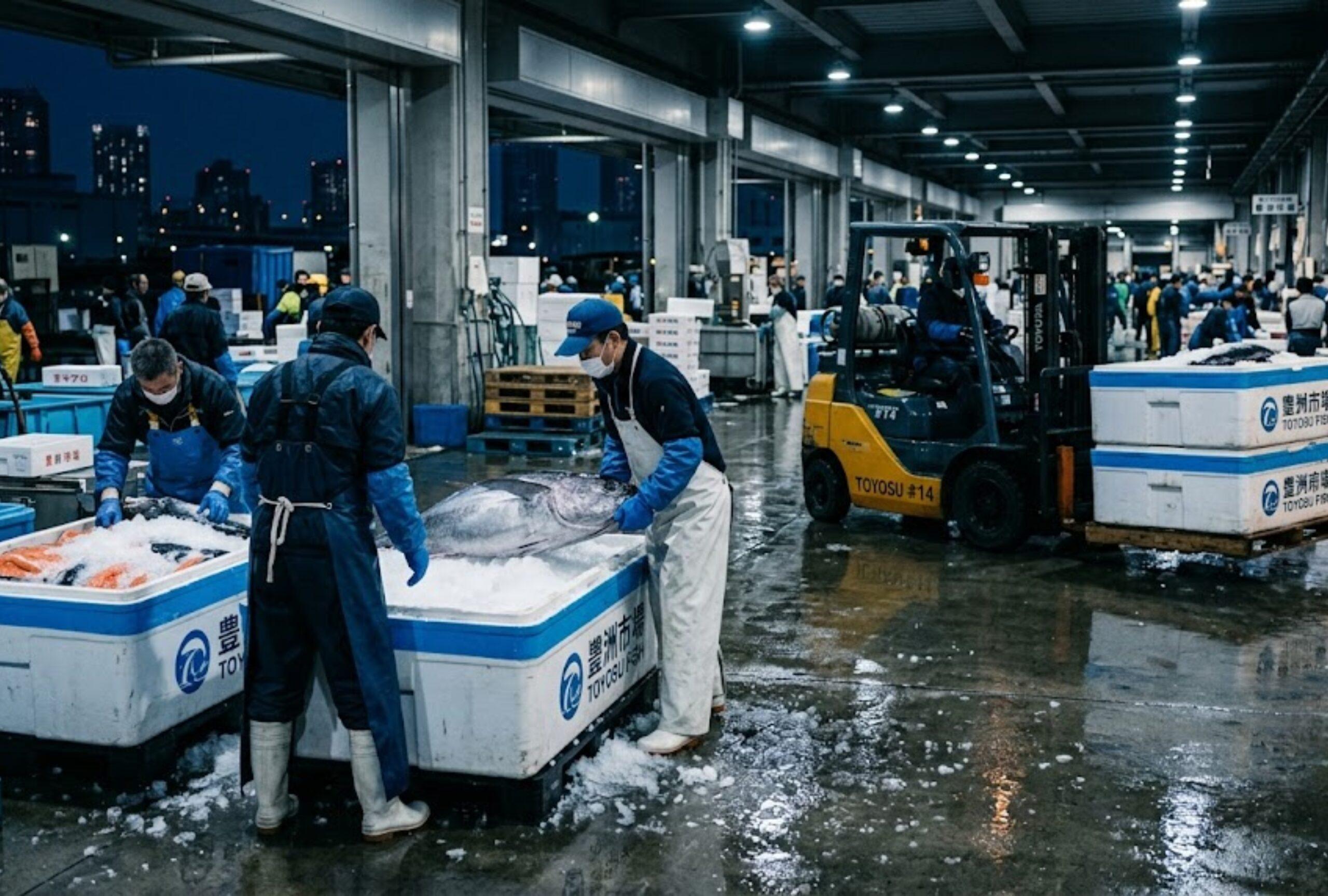
Double-wall insulated fish tubs are built to protect Tsukiji-grade freshness from dock to destination.
What “Tsukiji-Grade Freshness” Really Means
The phrase gets used loosely, but in the seafood trade it has a very specific meaning. Tsukiji — and now Toyosu, its successor — set the benchmark for how fish should look, smell, and feel at the point of sale: firm flesh, clear eyes, no discoloration, and no drop in internal temperature between the boat and the buyer. Achieving that isn’t about one clever trick. It’s about an unbroken cold chain, where the fish never sits in a temperature zone that lets bacteria multiply or texture break down. The moment that chain breaks — even for twenty or thirty minutes in a warm loading bay — the fish can no longer be sold at the grade a Tokyo buyer expects. That single fact is why the container the fish travels in is treated as seriously as the vessel that caught it.
The Cold Chain Challenge Facing Japanese Seafood Exporters
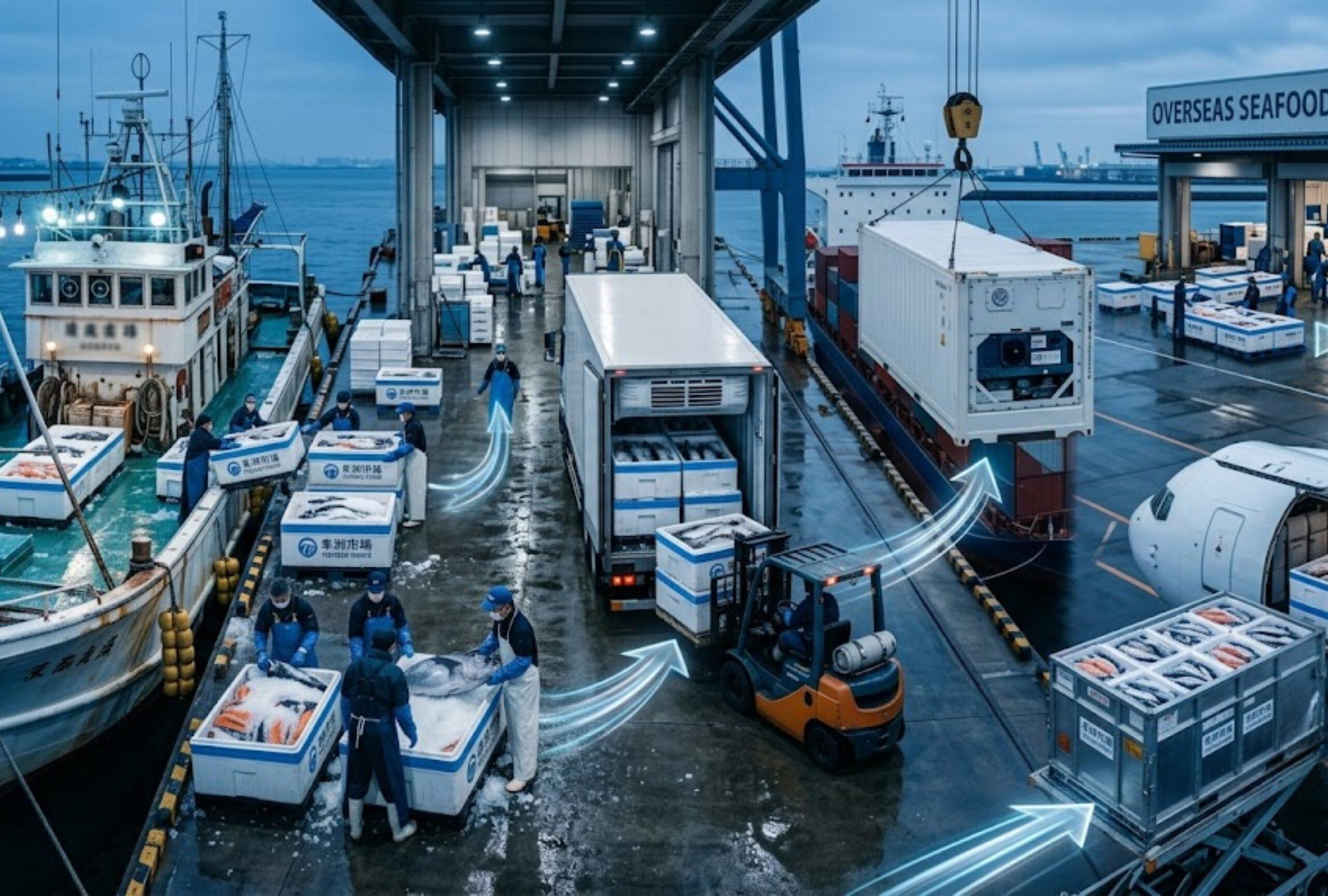
Japan imports a large share of the seafood it consumes, and it also re-exports significant volumes of processed and premium-grade fish to markets across Asia, Europe, and North America. Both directions of that trade share the same weak point: the journey between the source and the final buyer is long, humid, and unpredictable. A shipment might move from a fishing vessel to a sorting facility, then to a cold store, then onto a truck, then through a port, and finally onto an aircraft or vessel — sometimes crossing five or six handling points before it reaches its destination. Ordinary boxes, thin-walled plastic crates, or wooden containers simply cannot hold a stable internal temperature across that many transfers. Every gap in insulation becomes a gap in freshness, and in a market as quality-sensitive as Japan’s, that gap shows up immediately in the price the fish fetches.
What Are Double-Wall Insulated Fish Tubs?
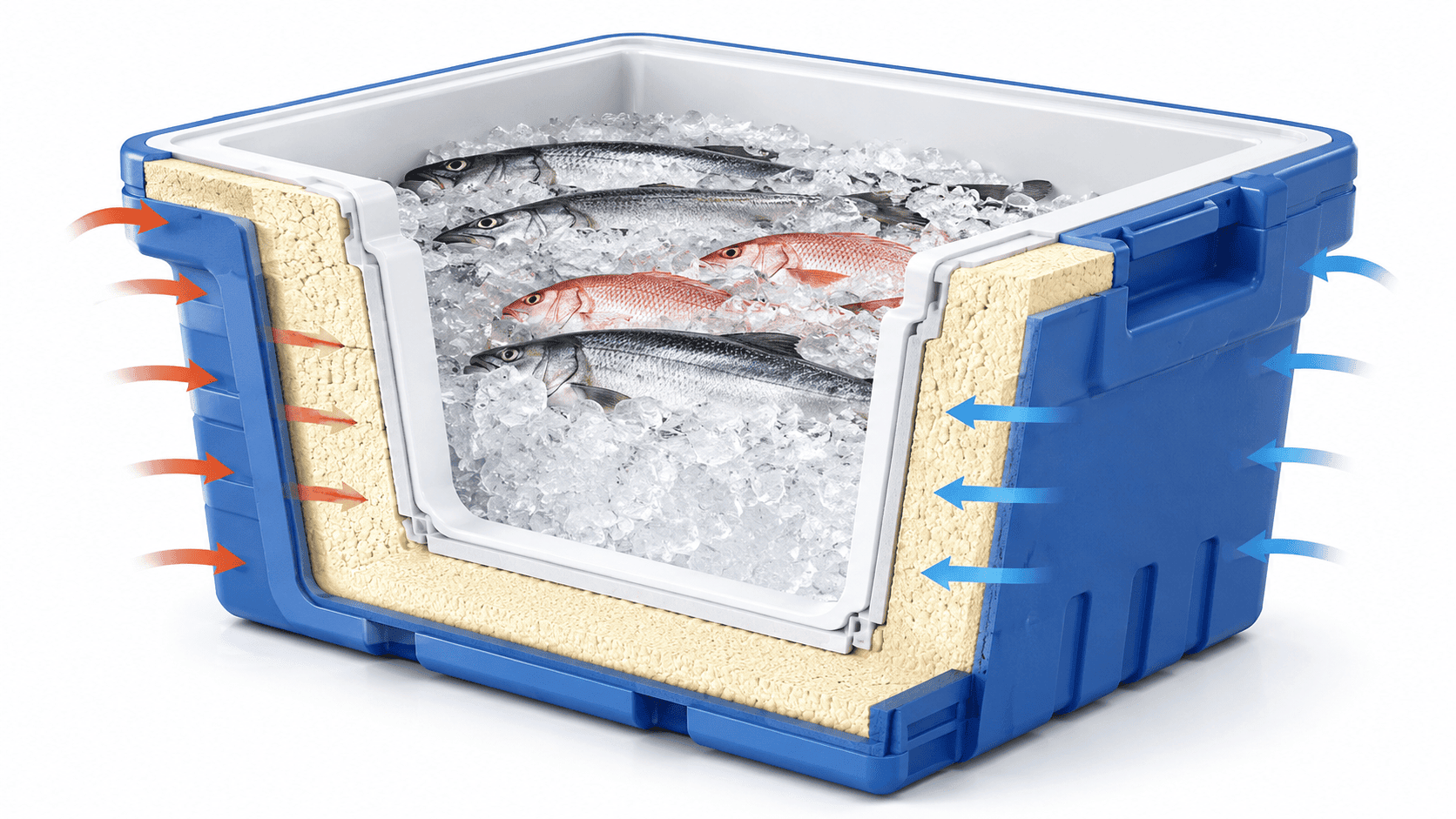
A double-wall insulated fish tub is not just a bigger cooler box. It is a purpose-built container with two layers of rotationally or injection-moulded plastic, and a core of dense insulating foam sandwiched between them. The outer wall handles the rough, physical reality of export logistics — forklifts, stacking, long-haul trucks, and repeated washdowns. The inner wall keeps direct contact with the fish and ice, and the foam core in between is what actually stops heat from migrating in. Together, this construction holds internal temperature far longer than a single-wall plastic bin or a traditional wooden fish box, which is the entire point when Tsukiji-grade freshness is on the line.
PE and PUR foam insulation layers keep internal temperature stable for hours at a stretch.
How the Insulation Technology Actually Works
Polarplas manufactures these tubs using rotational and injection moulding technology, with two main insulation approaches depending on the product line: PE foamed and PUR (polyurethane) foamed construction. The body itself is built from LLDPE or HDPE — materials chosen specifically for their strength-to-weight ratio and their ability to survive extreme conditions, from sub-Saharan heat to North American winters. When ice is packed against the inner wall, the foam core acts as a thermal barrier, dramatically slowing the rate at which the ice melts and the internal temperature rises. In practical terms, this means a shipment can sit in a hot loading yard, wait through customs, or travel an extra leg of the journey without the fish crossing into a temperature zone where spoilage begins.
Why Japanese Buyers Demand More From Their Fish Containers
Japanese seafood buyers are known for applying some of the strictest quality checks in the world, and that scrutiny extends well beyond the fish itself — the equipment it arrives in is inspected too. A container that shows delamination, cracked walls, or residue build-up raises immediate questions about hygiene and handling standards upstream. This is why exporters supplying Japan, or competing to match Japanese freshness standards in other markets, look for containers that are easy to sanitize, resistant to odor retention, and built to survive years of repeated use without breaking down. A tub that fails after a few dozen cycles isn’t just a cost problem — it’s a quality-control risk that can jeopardize an entire buyer relationship.
Key Features Japanese Seafood Exporters Look For
| Requirement | Why It Matters for Tsukiji-Grade Export |
|---|---|
| Long ice retention | Keeps fish between 0°C–4°C across multi-leg journeys without re-icing |
| Hygienic, smooth interior | Prevents bacterial build-up and meets food-safety inspection standards |
| Stackability | Maximizes container/truck space without crushing product |
| Drain systems | Allows melted ice to be released without contaminating the catch |
| Durable double-wall build | Withstands forklifts, repeated washdowns, and years of reuse |
| Traceability | RFID, barcode, or QR tracking to log handling from dock to destination |
That last point — traceability — is becoming increasingly important as buyers ask for proof of an unbroken cold chain, not just an assurance of one. Polarplas fish tubs can be fitted with RFID tags, barcodes, or QR codes, along with in-mould serial numbering that records the manufacturing batch. For an exporter, that means every tub can be tied back to a manufacturing date and tracked through its handling history — evidence that matters when a Japanese buyer wants documentation, not just a promise.
Built-in drain systems and hygienic surfaces keep the catch clean from dock to delivery.
From Toyosu to the World: The Export Journey
Picture a shipment of mackerel processed near a Japanese port and destined for a restaurant chain overseas. It leaves the processing floor packed in ice inside a double-wall insulated tub, moves by truck to the airport or seaport, sits briefly in a holding area, transfers onto a vessel or aircraft, clears customs at the destination, and finally reaches a distributor’s cold store. At no point in that chain can the internal temperature be allowed to climb. A well-built insulated tub is what makes that possible without relying on continuous mechanical refrigeration at every stage — the insulation itself does the work, which also means lower energy costs and fewer points of mechanical failure along the way.
Why Exporters Choose Polarplas Fish Tubs
Polarplas, a sister concern of Seaplast (India) Private Limited, manufactures its insulated tubs specifically for the export market, which shapes every part of the design — from wall thickness to the raw material grade used. The PE foamed tub and bin range is available across a wide span of capacities, from smaller units suited to boat-side sorting up to large 1000-litre-plus containers built for bulk export volumes, so exporters can match the container size to the scale of their operation rather than overpaying for capacity they don’t need. Every tub is designed to perform in extreme conditions, whether that’s the heat of a tropical port or the cold of a North American winter dock — the same double-wall insulation that protects fish in one climate protects it in the other.
Sourcing insulated fish tubs for export to or within Japan? Get in touch with the Polarplas team to discuss capacity, customization, and lead times for your shipment schedule.
Sustainability Matters Here Too
Reusability is a quiet but important part of this story. A double-wall insulated tub isn’t a single-use item — it’s designed to be washed, refilled, and reused across hundreds of cycles, which reduces the packaging waste that comes with disposable fish boxes or degrading wooden crates. For exporters working with Japanese buyers who increasingly factor sustainability into their sourcing decisions, being able to point to a reusable, recyclable container system is a genuine advantage, not just an environmental talking point.
Choosing the Right Size for Your Operation
Exporters shipping small, high-value batches of premium tuna or sashimi-grade fish typically need smaller, easier-to-handle tubs that can be moved quickly through sorting and grading. Larger processors moving high volumes of mackerel, squid, or mixed catch toward bulk export usually need the higher-capacity end of the range. Getting this sizing decision right affects everything downstream — how much ice is needed, how the tubs stack in a container, and how efficiently a warehouse team can move product during peak season. It’s worth discussing your specific shipment profile with a supplier before settling on a single tub size across your whole operation.
Frequently Asked Questions
What makes a fish tub “double-wall insulated”?
It means the container has two layers of plastic — an outer and an inner wall — with a core of PE or PUR foam insulation between them, which slows heat transfer far more effectively than a single-wall plastic box.
How long can these tubs keep fish cold?
Depending on the tub size, ice quantity, and ambient temperature, a well-insulated double-wall tub can maintain fish at 0°C–4°C for many hours, and in many cases for a full day or more, which is why they’re used for long, multi-leg export journeys.
Why do Japanese seafood exporters specifically need this level of insulation?
Japan’s seafood market operates on a very strict freshness standard, popularly linked to markets like Tsukiji and Toyosu. Any break in the cold chain shows up as a visible drop in fish quality, so exporters supplying or competing with that market rely on containers that hold temperature reliably across long, unpredictable logistics chains.
Are these tubs reusable, or are they single-use like foam boxes?
They’re built for repeated reuse — washed, refilled, and cycled back into operation hundreds of times, unlike disposable foam or wooden fish boxes that typically get discarded after one or two trips.
What materials are used to make Polarplas fish tubs?
The outer body is made from LLDPE or HDPE using rotational or injection moulding, with PE or PUR foam injected between the walls for insulation.
Can these tubs be tracked for supply chain traceability?
Yes — Polarplas tubs can be fitted with RFID tags, barcodes, or QR codes, along with in-mould serial numbering, so exporters can trace a container’s manufacturing batch and handling history.
The Bottom Line
Tsukiji-grade freshness isn’t a marketing phrase — it’s an operational standard that depends entirely on an unbroken cold chain, and that chain is only as strong as the containers carrying the fish through it. For Japanese seafood exporters, and for any exporter trying to match that same bar in international markets, double-wall insulated fish tubs are what make the difference between fish that arrives at grade and fish that doesn’t. That’s the reason Polarplas built its entire fish tub range around export-grade durability and insulation performance in the first place — because in this business, freshness is only as good as the box it travels in.
