
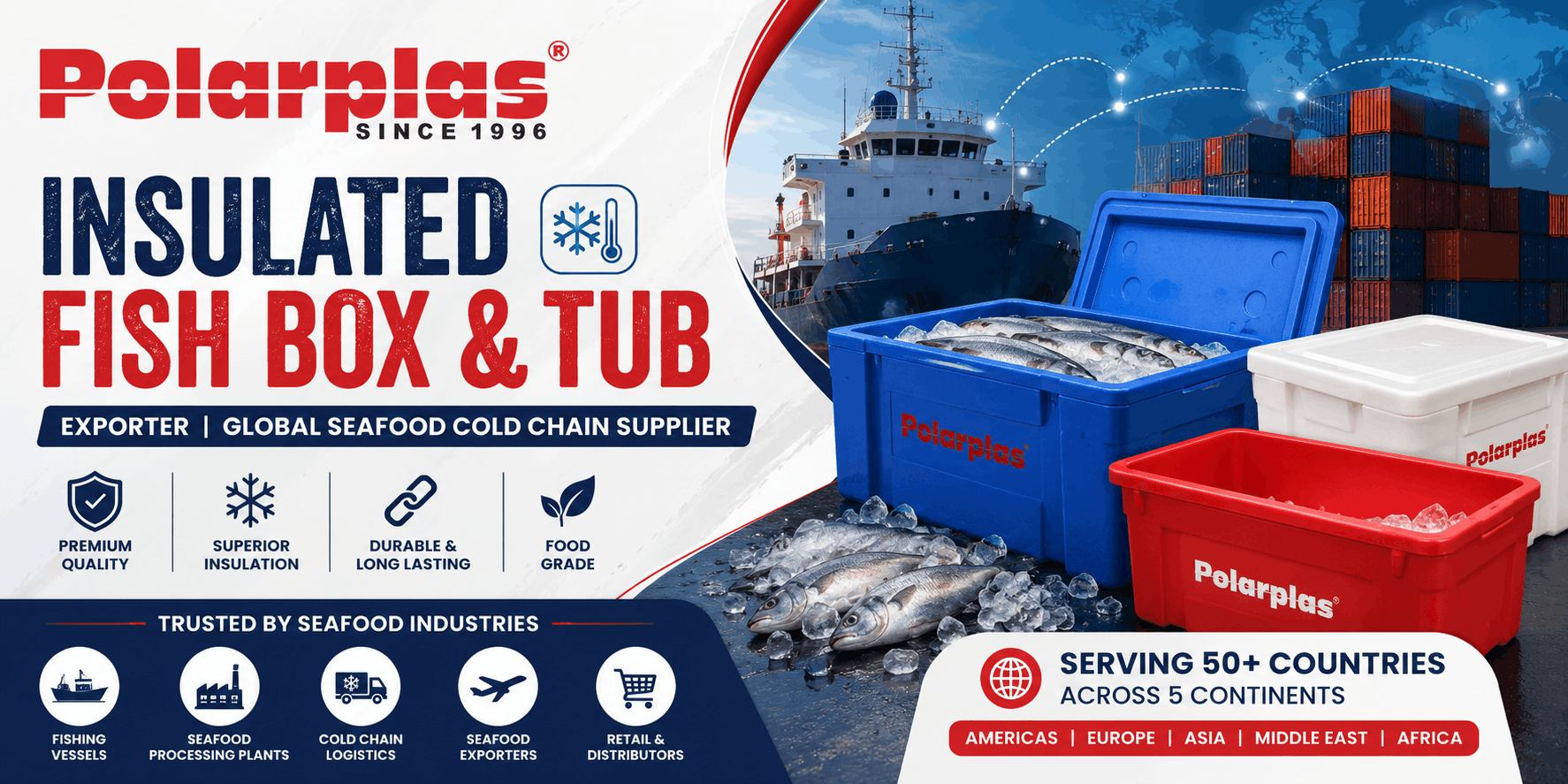
As a leading insulated fish box exporter, Polarplas has been manufacturing double-wall insulated fish boxes and tubs since 1996, supplying seafood industries across five continents. Whether you run a fishing vessel, a seafood processing plant, or an export business, choosing the right insulated fish tub supplier directly affects product freshness, shelf life, and profitability during transport.
In this guide, we cover why insulated fish boxes are critical to the global seafood cold chain, what makes an export-grade box different from an ordinary one, and how Polarplas — a sister concern of Seaplast (India) Private Limited — serves seafood businesses in Europe, the Americas, Asia, the Middle East, and Africa with reliable, export-ready cold chain packaging.
Why Insulated Fish Boxes Are in High Global Demand
The global seafood trade moves billions of dollars’ worth of fresh and frozen catch every year, and almost none of it survives the journey without proper cold chain packaging. An insulated fish box is often the single most important piece of equipment standing between a fresh catch and a spoiled shipment. As seafood exports grow across Latin America, Southeast Asia, the Middle East, and Africa, demand for reliable insulated fish box manufacturers has grown right alongside it.
- Rising seafood exports — Countries like Ecuador, Chile, Vietnam, and Indonesia continue to post double-digit growth in seafood export value year over year.
- Longer supply chains — Catch now often travels thousands of kilometers by sea, air, and road before reaching the end buyer, increasing the need for extended temperature retention.
- Stricter import regulations — Markets like the EU, US, and UK require hygienic, food-grade, easy-to-clean containers as part of import compliance.
- Shift away from traditional methods — Wooden crates and thermocol boxes are being phased out in favor of reusable, durable, rotomoulded plastic containers.
Polarplas Global Reach: Insulated Fish Box Supplier Across the World
Polarplas exports insulated fish boxes and tubs to seafood businesses across major fishing and processing economies worldwide. Below is an overview of the key regions and countries we currently serve as a trusted insulated fish box exporter:
| Region | Countries Served |
|---|---|
| Europe | United Kingdom, Norway, Sweden, Germany, Denmark, Poland, Greece, France, Spain, Iceland |
| Americas | United States, Canada, Chile, Ecuador |
| Asia-Pacific | Japan, Vietnam, Thailand, Indonesia, Philippines, Bangladesh, Sri Lanka, Australia |
| Middle East | UAE, Saudi Arabia |
| Africa | Kenya, Ethiopia, South Africa, Morocco, Nigeria |
Key Export Markets We Serve: A Closer Look
Every seafood market has its own handling requirements, climate challenges, and regulatory expectations. Here’s how Polarplas insulated fish boxes and tubs support some of our key international markets:
Chile & Ecuador (South America)
Chile is the world’s largest salmon exporter and Ecuador leads global shrimp exports. Both require high-volume, stackable insulated fish tubs that withstand long sea freight routes to North America, Europe, and Asia without compromising product temperature.
Norway (Europe)
As one of Europe’s largest seafood exporters of salmon and cod, Norwegian processors need double-wall insulated containers that perform reliably in cold climates while meeting strict EU food-contact packaging standards.
UAE & Saudi Arabia (Middle East)
The UAE functions as a major seafood re-export and logistics hub for the wider Gulf region. Businesses here need insulated fish boxes that can handle extreme ambient heat while keeping catch cold during transit and distribution.
Indonesia, Thailand & Philippines (Southeast Asia)
These countries are major tuna, shrimp, and mixed seafood processing hubs. High humidity and tropical conditions make durable, corrosion-free, easy-to-sanitize insulated fish tubs essential for processing plants and export packing lines.
Bangladesh & Sri Lanka (South Asia)
Growing shrimp and fish export industries in both countries are shifting from traditional ice-and-crate methods to reusable insulated containers to meet international buyer hygiene requirements.
South Africa, Nigeria & Morocco (Africa)
With expanding fishing fleets and seafood processing capacity, African exporters increasingly need export-grade insulated fish boxes to access premium European and Middle Eastern seafood markets.
Canada & Australia
Developed cold chain markets with strict food safety regulations, where processors prioritize long-term durability, stackability, and certified food-grade materials over short-term cost savings.
USA, UK & Japan
Established seafood import markets like the US, UK, and Japan (including Tokyo’s Toyosu Market) demand consistent, hygienic, FDA and EU-compliant insulated fish tub solutions for high-volume daily distribution.
What Makes Polarplas Insulated Fish Boxes Different
Not every insulated fish box manufacturer builds for export-grade performance. Polarplas products are specifically engineered using rotational and injection moulding technology to meet the demanding requirements of international seafood logistics:
- Double-wall insulation — Injected PE (Polyethylene) and PU (Polyurethane) foaming for maximum temperature retention over long transit times.
- Premium raw material — Manufactured in LLDPE or HDPE, both UV-stabilized for outdoor and marine use.
- Built for extremes — Designed to perform in conditions ranging from sub-Saharan heat to North American cold.
- Hygienic, food-grade design — Smooth, non-porous surfaces that are easy to clean and sanitize between uses, reducing contamination risk.
- Stackable & space-efficient — Optimized for container shipping, cold storage, and processing-plant handling.
- Available in multiple capacities — From compact tubs to large-volume bins suited to different vessel and processing-plant needs.
Choosing the Right Capacity for Your Business
Selecting the correct size of insulated fish tub depends on your daily catch volume, storage duration, and transport method. Here is a general capacity guide used across our export markets:
| Business Type | Recommended Capacity Range |
|---|---|
| Small-scale fishing vessels / local markets | 50L – 100L |
| Mid-size processing units | 150L – 300L |
| Large processing plants / bulk transport | 460L – 500L |
| Export-scale bulk storage & shipping | 500L – 1250L |
Industries & Applications
- Fishing vessels — on-board catch storage and preservation
- Seafood processing plants — in-line handling and hygienic storage
- Cold storage warehouses — bulk short and long-term storage
- Export & distribution — container shipping and cross-border logistics
- Retail & wholesale seafood distribution — last-mile cold chain handling
Why Global Seafood Exporters Choose Polarplas
Polarplas, a sister concern of Seaplast (India) Private Limited, has been manufacturing insulated plastic products for the export market since 1996. Our insulated fish boxes and tubs are exclusively designed to meet the durability, deformation-resistance, and quality requirements of international seafood exporters — not just domestic use.
With decades of manufacturing experience, rotational and injection moulding technology, and a track record of supplying seafood businesses across Europe, the Americas, Asia, the Middle East, and Africa, Polarplas has become a trusted insulated fish box exporter for businesses that cannot afford spoilage, delays, or inconsistent cold chain performance.
To discuss your requirement or request a quote for your country’s specifications, you can contact the Polarplas export team or browse our full Insulated Fish Tub & Box product range.
Frequently Asked Questions (FAQs)
1. What is an insulated fish box used for?
An insulated fish box is a double-wall plastic container used to store and transport fresh or frozen seafood while maintaining a controlled low temperature, preventing spoilage and bacterial growth during handling, storage, and export.
2. Which countries does Polarplas export insulated fish boxes to?
Polarplas exports insulated fish boxes and tubs to seafood businesses across the UK, Europe (Norway, Sweden, Germany, Denmark, Poland, Greece, France, Spain, Iceland), the Americas (USA, Canada, Chile, Ecuador), Asia-Pacific (Japan, Vietnam, Thailand, Indonesia, Philippines, Bangladesh, Sri Lanka, Australia), the Middle East (UAE, Saudi Arabia), and Africa (Kenya, Ethiopia, South Africa, Morocco, Nigeria).
3. What material are Polarplas insulated fish boxes made from?
Polarplas insulated fish boxes are manufactured using LLDPE or HDPE raw material with double-wall insulation using injected PE and PU foaming, providing durability, deformation resistance, and long-lasting temperature retention.
4. How long can an insulated fish box keep seafood cold?
Depending on the box size, insulation thickness, and ice-to-product ratio used, a quality double-wall insulated fish box can maintain safe cold temperatures for extended transport durations, making it suitable for both domestic distribution and long-distance export shipping.
5. What size insulated fish box should I choose for export?
For export-scale bulk storage and shipping, capacities in the 500L to 1250L range are commonly used, while smaller 50L–300L tubs suit local vessels and mid-size processing units. The right choice depends on your catch volume and shipping container layout.
6. Are Polarplas insulated fish boxes suitable for hot climates like the Middle East or Africa?
Yes. Polarplas products are engineered to perform in extreme conditions, from sub-Saharan heat to North American cold, making them suitable for use across the Middle East, Africa, Southeast Asia, and other high-temperature export markets.
7. Why choose Polarplas over other insulated fish box manufacturers?
Polarplas has manufactured export-focused insulated plastic products since 1996, as a sister concern of Seaplast (India) Private Limited. Our products are specifically designed for durability, deformation resistance, and hygienic performance to meet the requirements of international seafood exporters rather than only local markets.
