
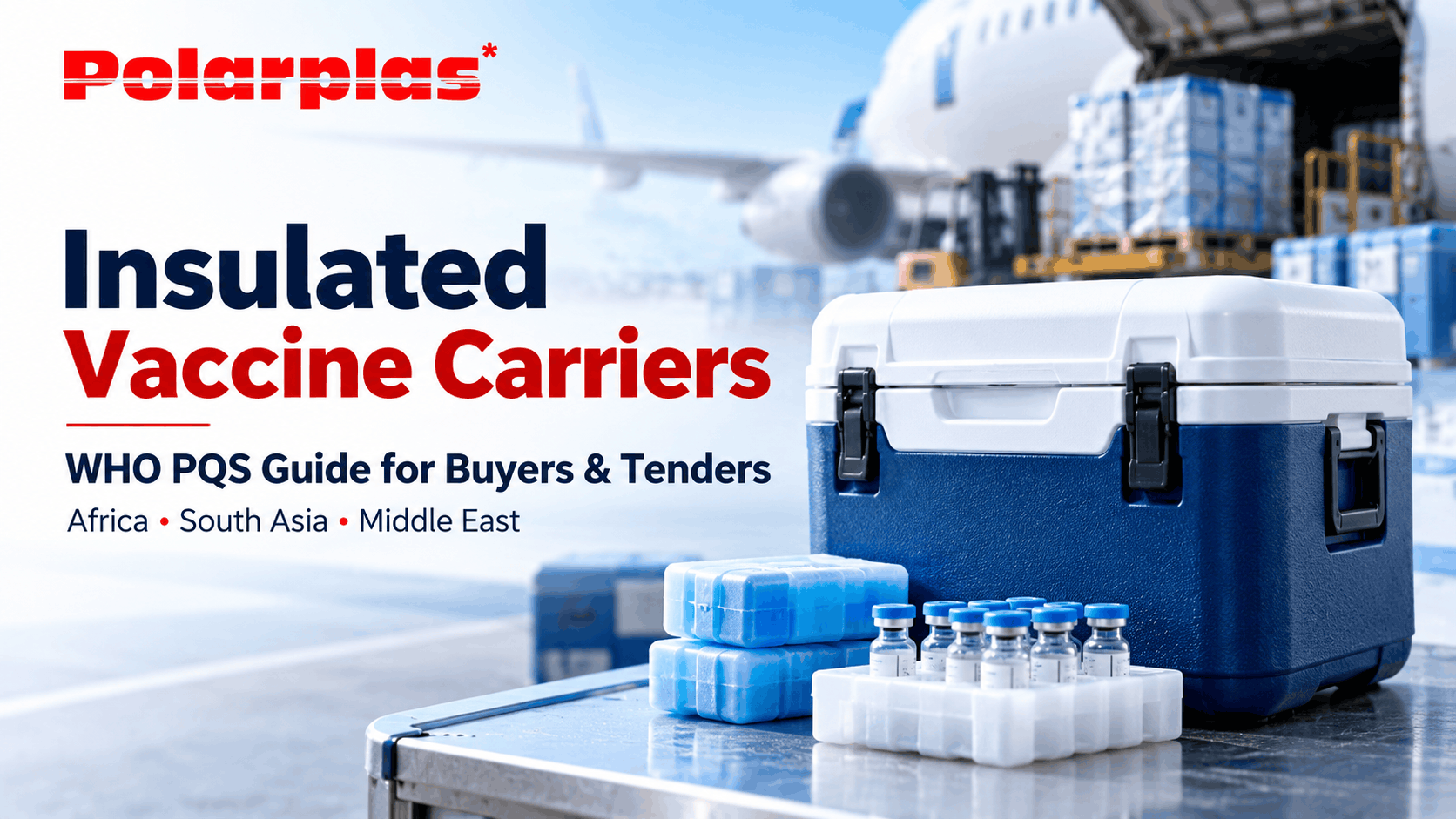
Choosing an insulated vaccine carrier is never just a purchase order. For health ministries, NGOs, distributors and tender teams across Africa, South Asia and the Middle East, one weak carrier can mean a spoiled vaccine batch, a failed outreach day and a wasted budget line.
This guide explains how WHO PQS works, how to read cold-life numbers, what to write into your tender, and how Polarplas, an insulated vaccine carrier manufacturer in India since 1996, builds rugged rotational-moulded carriers for hot, remote supply routes.
Quick Answer: Key Takeaways for Buyers
- WHO PQS (Performance, Quality and Safety) is the benchmark most global immunization tenders use to judge a vaccine carrier.
- Cold life at +43 °C is the single most useful number for hot regions such as the Sahel, Gulf and Indo-Gangetic plains.
- Always verify a model’s PQS status and validity date in the WHO database before bidding.
- Large-format carriers (25 L and 60 L) suit bulk transport, store-to-store moves and campaigns where the tender permits.
- Ask for datasheets, packing details and export documents in writing before you finalise a supplier.
Why an Insulated Vaccine Carrier Matters in Hot, Remote Regions
Most vaccines must stay between +2 °C and +8 °C from the cold room to the child’s arm. Some are also freeze-sensitive, so going too cold is as damaging as going too warm. The last leg of the journey, usually by motorbike, boat, bus or on foot, is where the cold chain is weakest. An insulated vaccine carrier is the portable shield for that leg.
The challenge is bigger in our three focus regions. Rural Africa faces long distances, unpaved roads and unreliable electricity. South Asia runs some of the world’s largest immunization drives, with huge volumes moving through monsoon humidity and summer heat. The Middle East deals with extreme summer temperatures, where a parked vehicle can behave like an oven. If you also move seafood or food in these climates, our note on cold chain containers in Mombasa shows how the same insulation science applies on the East African coast.
What Is WHO PQS and Why Do Tenders Ask for It?
WHO PQS is a programme of the World Health Organization that publishes performance specifications and independent test protocols for immunization equipment. Products that pass type-testing in an independent laboratory are listed as prequalified. Procurement agencies, donors and national programmes use this list to avoid buying equipment that looks good on paper but fails in the field. You can browse the official WHO immunization devices database to see every listed product.
Vaccine carriers fall under category E004, which covers cold boxes and vaccine carriers. The test protocol for a standard carrier is documented in the WHO E004/VC01 type-testing protocol, which checks dimensions, weights, storage capacity and thermal performance. Programmes that buy through UNICEF Supply Division or alongside Gavi-supported projects usually expect PQS-listed devices.
Two Carrier Types You Will See in Tenders
Standard (VC01)
A thermally insulated carrier used with frozen or conditioned water packs. It is classed as short range or long range, depending on how many hours it protects vaccines at +43 °C.
Freeze-Prevention (VC02)
Built for freeze-sensitive vaccines. The design keeps the vaccine compartment from dropping into freezing temperatures even when ice packs are in direct use.
Coolant Packs (E005/IP01)
PQS carriers are tested with water packs that follow the E005/IP01 specification. Pack size, number and conditioning method all affect the final hold time.
How to Read Vaccine Carrier Specifications
A datasheet can look like a wall of numbers. Focus on the terms below and you will compare any two carriers fairly, whether they come from India, Europe or China.
| Term | What It Means | Why Buyers Care |
|---|---|---|
| Cold life (+43 °C) | How long the carrier protects vaccines in a hot ambient with frozen packs. | Best indicator for Africa, Gulf and South Asian summers. |
| Cool life (+43 °C) | Protection time when cooled, not frozen, packs are used. | Matters for freeze-sensitive vaccines. |
| Warm life (−20 °C) | Protection against freezing in very cold ambient conditions. | Useful for highland and winter routes. |
| Vaccine storage capacity | Usable litres for vaccine boxes, excluding the pack space. | Decides how many doses fit per trip. |
| Insulation material and thickness | Foam type and wall depth, commonly polyurethane. | Drives hold time and carrier weight. |
| Loaded weight | Weight with packs and vaccines inside. | Health workers carry it for hours. |
Competitor Benchmark: What Market Listings Tell Us
We studied WHO PQS listings and supplier catalogues from leading vaccine carrier suppliers to see where the market stands. The pattern is clear, and it helps you judge any quote you receive.
| Parameter | Typical in Listed Small Carriers | Takeaway for Your Tender |
|---|---|---|
| Long-range cold life at +43 °C | Roughly 30 to 40+ hours | Treat 30 hours as a sensible floor for remote routes. |
| Short-range cold life | Around 20 hours | Fine for same-day urban sessions only. |
| Insulation | Mostly polyurethane, about 28 to 60 mm thick | Thicker walls cost more weight, so balance both. |
| Outer shell | HDPE or polyethylene | Impact and UV resistance are essential. |
| Coolant | 2 to 4 water packs, 0.3 to 0.6 litre each | Check packs are supplied with the carrier. |
| Weight when loaded | About 2 to 8 kg | Compare against the carrying capacity of field staff. |
Most competitor pages target phrases such as vaccine carrier box with ice packs, cold chain equipment and WHO prequalified vaccine carrier. Few of them explain regional conditions or give a buyer’s checklist. That gap is exactly what this guide fills for procurement teams in Africa, South Asia and the Middle East.
Tender Checklist for Buying an Insulated Vaccine Carrier
10 Things to Put in Your Tender or RFQ
- Required capacity in litres and the vaccine box formats it must hold.
- Minimum cold life at +43 °C, stated in hours, and the test method used.
- PQS code, status and validity date, if prequalification is mandatory.
- Insulation type, wall thickness and shell material (LLDPE or HDPE).
- Number and size of coolant packs supplied with each carrier.
- Lid design, gasket and latch strength for repeated field use.
- Marking and traceability, such as serial numbers, QR codes or RFID.
- Colour, branding and language labels for your programme.
- Packing, carton size and container-loading plan for export.
- Warranty terms, spare parts and after-sales support in your country.
Before you award a contract, always look up the exact model in the WHO database. Listings carry a status and a validity date, and a product that is suspended or withdrawn must not be purchased. Requesting a sample for your own temperature logging is a smart extra step.
Polarplas: Insulated Vaccine Carrier Manufacturer Built for Tough Routes
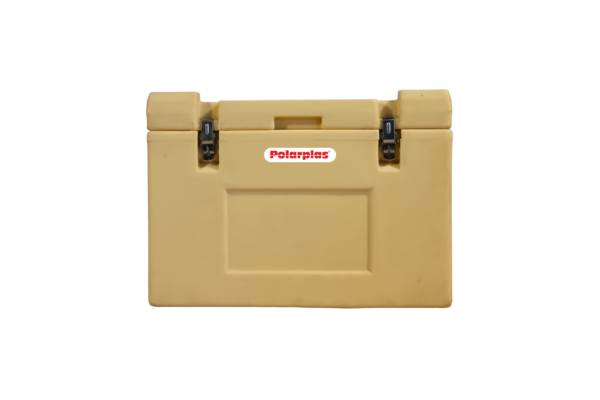
Polarplas India Private Limited is a sister concern of Seaplast (India) Private Limited and has made plastic products by rotational and injection moulding since 1996. Our products are designed for the export market, with a focus on durability, low deformation and consistent quality. The same engineering that protects fish at sea now protects vaccines on land through our insulated vaccine carrier range.
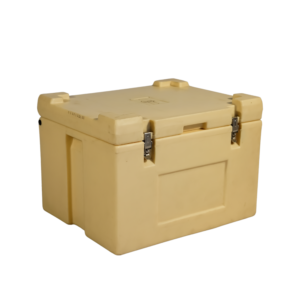
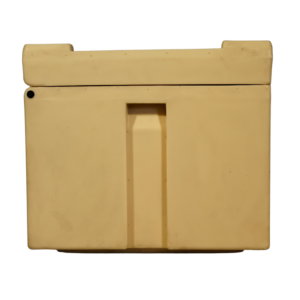
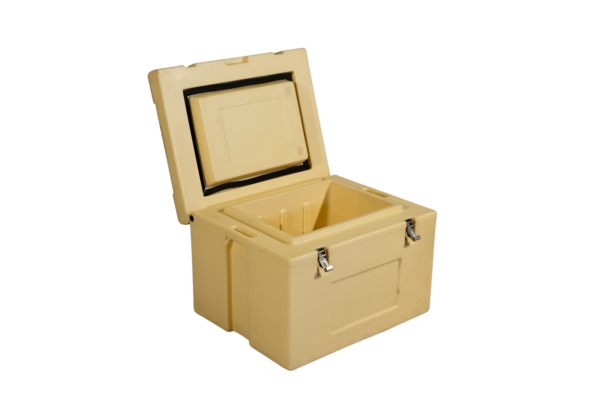
Double-Wall Insulation
Products are available with PE or PU foam injected between the walls, in LLDPE or HDPE material, to hold the temperature of whatever is inside.
Rugged Moulded Body
Rotational moulding gives a seamless shell that resists knocks, rough handling and harsh sun, which suits long, bumpy distribution routes.
Smart Tracking
Choose RFID tags, barcodes, QR codes or in-moulded serial numbers to trace every carrier from factory to last mile.
25 Litre Vaccine Carrier Specifications (PP-DVC25P1U)
| Dimension | In mm | In inches |
|---|---|---|
| External length x width x height | 590 x 480 x 440 | 23 x 19 x 17 |
| Internal length x width x height | 400 x 290 x 240 | 16 x 11 x 9 |
| Gross volume | 25 litres | 6.6 gallons |
You can open the 25 litre vaccine carrier page for colour options and the downloadable datasheet. For higher volumes, the 60 litre vaccine carrier carries more per trip. Need a special size, logo or colour for your programme? Our custom moulding service can develop it with you.
Honest Note on PQS Status
PQS prequalification is granted to specific models after independent testing, and the WHO list is the only source of truth. If your tender strictly requires a prequalified E004 device, confirm the exact model’s current status in the WHO database before bidding. Polarplas will gladly share datasheets, dimensional drawings and quality information on request.
Which Carrier for Which Job?
Small prequalified carriers of one to three litres are built for the health worker who walks a village session with a few vial boxes. Large-format carriers like our 25 L and 60 L models do a different job. They move bulk supplies between district stores, support mass campaigns, hold diluents and cold-chain consumables, and serve outreach teams who travel by vehicle. Where your programme specification allows, mixing both sizes gives the best coverage at the lowest cost. You can also pair them with our insulated coolers and ice boxes and KoolBoox range for broader cold-chain needs.
Regional Guide: Africa, South Asia and the Middle East
Africa
Buyers in Kenya, Nigeria, Ethiopia, Tanzania, Uganda and Ghana need carriers that survive long road legs, power cuts and strong sun. Prioritise thick insulation, durable lids and spare parts availability.
South Asia
India, Bangladesh, Nepal, Pakistan and Sri Lanka run frequent campaigns in hot, humid weather. Look for easy-to-clean surfaces, reliable seals and bulk packing that suits large tenders.
Middle East
The UAE, Saudi Arabia, Oman and Qatar see extreme summer heat and fast logistics. Choose UV-resistant shells, tight gaskets and clear labelling in Arabic or English.
Export Supply, Packing and Documents
A good insulated vaccine carrier supplier thinks about the container as carefully as the product. Share your target quantity, port of discharge and branding needs, and ask for carton dimensions, units per carton and a container-loading plan. Request commercial invoice, packing list, certificate of origin and any quality certificates your customs office needs. You can review our certificates and product gallery before you enquire, and read about our sustainability approach if your donor requires environmental information.
Seven Field Tips to Get the Best from Your Carrier
- Condition coolant packs exactly as the manufacturer instructs before packing.
- Pre-chill the empty carrier in a cold room when possible.
- Place vaccines in the middle, never touching frozen packs directly.
- Keep the lid closed and open it only when a vial is needed.
- Keep the carrier in shade, never on a hot vehicle floor or in direct sun.
- Use a temperature indicator or data logger for every trip.
- Clean and dry the carrier after each use and inspect the lid seal.
Frequently Asked Questions About Insulated Vaccine Carriers
What is an insulated vaccine carrier?
An insulated vaccine carrier is a portable, thermally insulated box that keeps vaccines at +2 °C to +8 °C during transport and outreach. It works with coolant packs and a well-sealed lid to slow heat transfer from the outside air.
What does WHO PQS mean for a vaccine carrier?
WHO PQS means a specific model has been independently tested against WHO performance specifications and listed in the WHO database. Procurement teams use it as proof of thermal performance, safety and quality.
How long does a vaccine carrier keep vaccines cold?
It depends on the model, insulation, number of packs and how often the lid is opened. Listed long-range carriers commonly show about 30 to 40 hours of cold life at +43 °C. Always check the datasheet for your exact model.
Which vaccine carrier suits Africa’s hot climate?
Choose a long-range design with thick polyurethane or PE foam insulation, a strong lid seal and a UV-resistant shell. Confirm the cold life is tested at +43 °C, and pick the capacity that matches your route length.
Can Polarplas supply vaccine carriers to Africa, South Asia and the Middle East?
Yes. Polarplas products are designed and manufactured for the export market. Send us your quantity, destination port and specification through our contact page, and our team will prepare a quotation.
What sizes of vaccine carrier does Polarplas offer?
Our standard range includes a 25 litre and a 60 litre vaccine carrier. Custom sizes, colours and markings can be developed through our custom moulding service.
Do I need ice packs or water packs?
Yes. Vaccine carriers rely on coolant packs, and PQS-tested carriers use water packs that follow the E005/IP01 specification. Follow the supplier’s conditioning instructions so vaccines are not frozen by accident.
How can I check if a vaccine carrier is PQS prequalified?
Search the WHO immunization devices database for the product code or manufacturer. Check the status and the validity date, and never buy a model shown as suspended or withdrawn.
Can Polarplas carriers be tracked?
Yes. Polarplas offers RFID tags, barcodes, QR codes and in-moulded serial numbering with month and year of manufacture, so each carrier can be traced from production to dispatch and beyond.
Get a Quote for Insulated Vaccine Carriers
Tell us your region, quantity and specification. Polarplas will send datasheets, packing details and a competitive export quotation for your insulated vaccine carrier requirement.
Request a Quote
View Vaccine Carriers
Email: sales@polarplas.com | Phone: +91 79 4007 3880 | WhatsApp
