
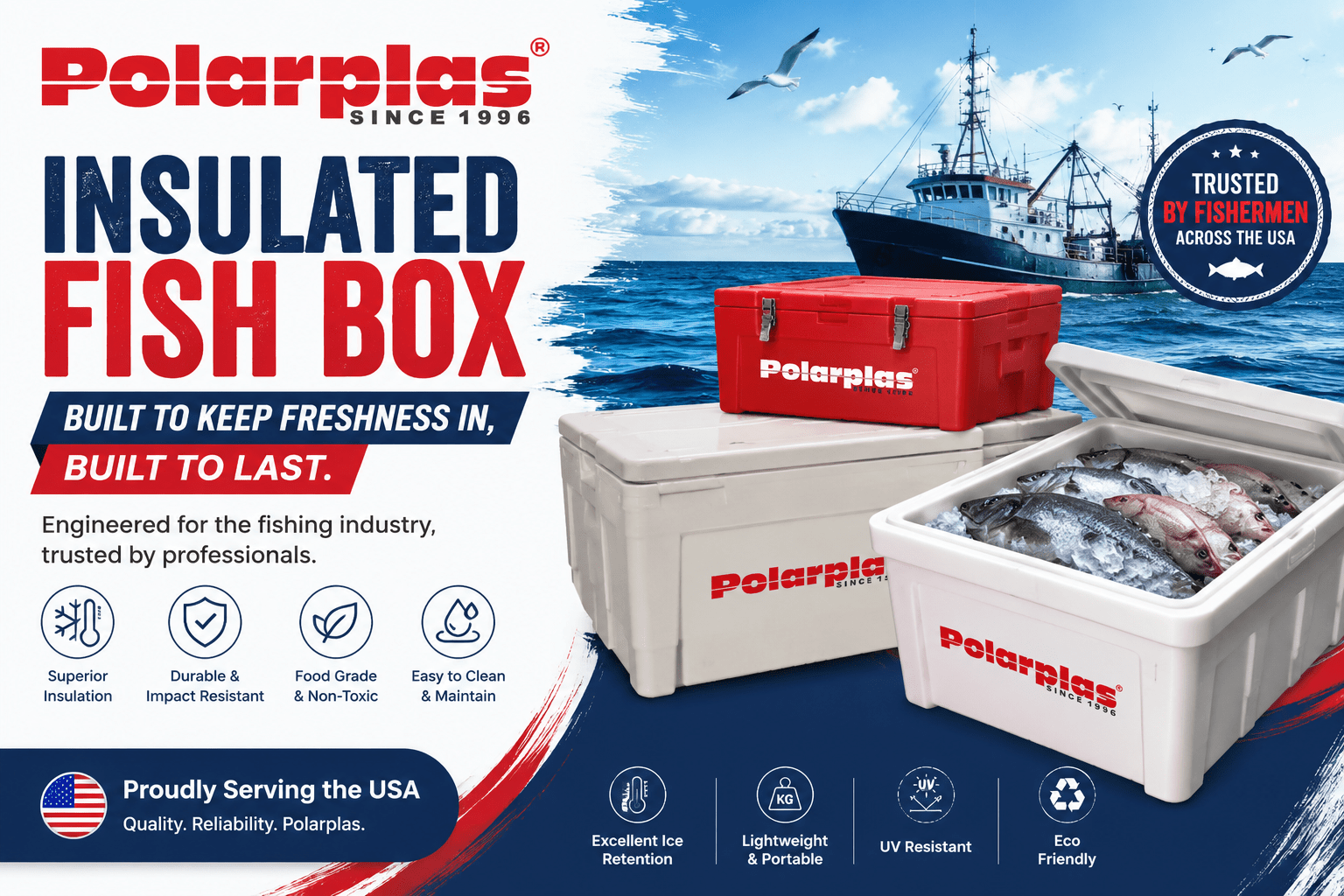
If you run a seafood business in the United States, the right insulated fish box in USA markets can make the difference between fresh, sellable catch and costly spoilage. So what should you know before you buy one? This guide covers what an insulated fish box is, why it matters for cold chain compliance, and which features to check first. It also shows how Polarplas builds insulated fish boxes and fish tubs for American fisheries, processors, exporters and food service operators.
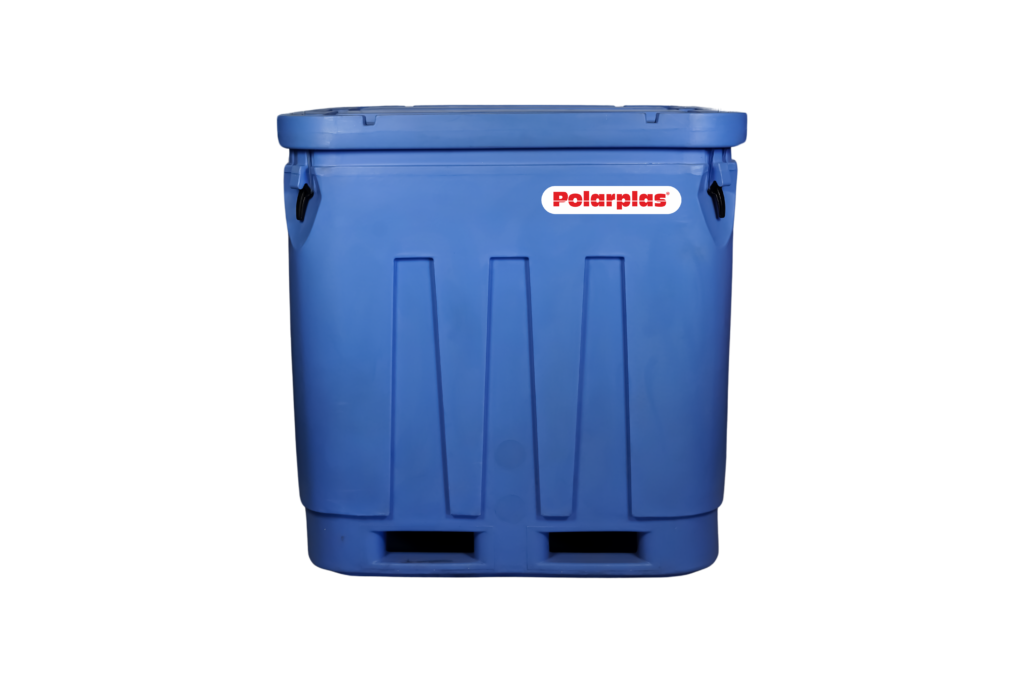
What Is an Insulated Fish Box?
An insulated fish box is a rotationally molded, double-wall plastic container. It has rigid PE or PUR foam insulation between the inner and outer shells. That foam core holds the ice in and keeps seafood at a safe, cold temperature for hours or even days. Notably, no electricity or mechanical refrigeration is needed. As a fully passive container, it works equally well on a fishing vessel deck, inside a processing plant, on a delivery truck, or stacked in a cold store. That’s exactly why demand for a reliable insulated fish box in USA supply chains has grown alongside the country’s seafood import and export volumes.
Meanwhile, an industrial insulated fish box, unlike a basic foam cooler, is built for thousands of reuse cycles. Manufacturers UV-stabilize the outer shell so it can survive outdoor use, while the food-grade inner shell stays easy to sanitize. Engineers also design the whole unit to stack safely once it’s loaded with ice, fish and water weight.
Why US Seafood Businesses Rely on Insulated Fish Boxes
The United States runs one of the largest seafood supply chains in the world. In fact, according to NOAA Fisheries, U.S. commercial fishermen landed 8.4 billion pounds of seafood valued at $5.1 billion in a single recent year. Consequently, a large share of that catch moves through several cold-chain touchpoints — boat, dock, processor, distributor, retailer — before it reaches a consumer’s plate. Each of those touchpoints depends on equipment that keeps product cold, clean and undamaged.
Regulation adds another layer of importance here. For instance, the FDA’s guidance on seafood safety makes clear that seafood should never sit above safe holding temperatures for long, since bacteria multiply quickly once product warms. As a result, an insulated fish box in USA cold chains becomes one of the simplest, most cost-effective ways to hold that safe temperature window during storage, dockside handling and transport — without needing a refrigerated truck for every short leg of the journey.
Why this matters for your business: Ultimately, every degree of temperature abuse shortens shelf life and increases spoilage risk. Therefore, a properly insulated fish box protects product quality, reduces waste, and helps demonstrate cold chain compliance during audits and inspections.
Key Features to Look for in an Insulated Fish Box in the USA
Not every plastic tub marketed as a “fish box” performs the same way in real operating conditions. So, before you buy, check for the following features:
- Wall-lock or fused double-wall construction — prevents the inner and outer shells from separating from the foam core over years of heavy use.
- Food-grade, FDA-compliant resin — ensures direct food contact safety and easy compliance during health inspections.
- High insulation (R-value) foam core — the thicker and denser the foam, the longer ice retention lasts.
- Drain plug option — allows meltwater to be released without tipping or emptying the whole box.
- UV-stabilized exterior — critical for boxes used outdoors on docks, decks or loading yards.
- Stackable, seamless design — smooth interior surfaces are easier to clean and sanitize between loads, and stackable walls save valuable storage and truck space.
- Reinforced lid with strap or clip closure — keeps the lid secure during transport and stacking.


Insulated Fish Box vs Insulated Fish Tub — What’s the Difference?
People often use these two terms interchangeably, but a practical distinction exists. An insulated fish box typically means a rigid, lidded, stackable container best suited to storage, retail cold holding and palletized transport. In contrast, an insulated fish tub tends to be deeper and higher-capacity. Teams use it for bulk on-deck catch handling, brining, icing large volumes of whole fish, or processing-line work where open, easy access matters more than a sealed lid.
Many seafood operations in the USA use both formats side by side. Crews rely on insulated fish tubs at the harvesting and initial processing stage, then switch to insulated fish boxes for onward storage, palletized cold-store stacking and last-mile distribution. Overall, Polarplas manufactures a full range of both, from compact 70-liter units up to 1400-liter bulk containers, so operations can standardize on one supplier across their entire cold chain.
Polarplas Insulated Fish Boxes & Containers — Built for the US Cold Chain
Polarplas designs and manufactures insulated fish boxes, insulated fish tubs and insulated cooler and ice box ranges engineered specifically to survive demanding cold chain conditions, from sub-zero export logistics to the extreme heat of a dockside loading yard. Every unit uses double-wall PE or PUR foaming technology, which locks the insulating foam core between two seamless plastic shells. This gives each container maximum ice retention and long-term durability.
For example, one option from the current range is the 1010L (DX-335) insulated container, a high-capacity unit built for bulk seafood storage, transport and export. It offers a gross volume of 266 gallons, a rubber-strap lid closure, an optional drain facility, and UV-resistant, FDA-compliant construction rated for heavy industrial use.


As an export-focused manufacturer, Polarplas builds every insulated fish box to standards that translate directly to US import, food-safety and cold-chain handling requirements. As a result, American seafood processors, distributors and logistics partners can bring these containers into their existing operations without extra hassle.
Industries in the USA That Rely on Insulated Fish Boxes
| Industry | Typical Use Case |
|---|---|
| Commercial fishing fleets | On-board icing and catch storage before dockside offload |
| Seafood processing plants | Raw material holding, line-side storage, batch handling |
| Cold storage & 3PL warehouses | Palletized stacking for bulk chilled or frozen inventory |
| Seafood distributors & wholesalers | Last-mile delivery in insulated boxes without full refrigeration |
| Exporters & importers | Container-load shipping of fresh or frozen seafood across borders |
| Restaurants & food service | Receiving and short-term back-of-house cold storage |
How to Choose the Right Size Insulated Fish Box
Sizing an insulated fish box comes down to daily throughput, storage duration and how you’ll handle the box. As a general guide, here’s what typically works best:
- 70L–200L: Small retail counters, independent fish markets, low daily volume operators.
- 300L–600L: Mid-size processors, regional distributors, restaurant supply operations.
- 1000L–1400L: High-volume processors, export shipments, bulk cold storage facilities.
Additionally, it’s worth thinking about how the box will move through your facility. Will workers lift it by hand, move it on a pallet jack, or load it by forklift? For this reason, bulk containers in the 1000L+ range generally come with pallet-compatible bases.
Maintenance & Care Tips for Longer Service Life
- Rinse and sanitize the box after every use to prevent bacterial buildup and odor retention.
- Store boxes out of direct, prolonged sunlight when not in use, so the UV-stabilized shell stays protected.
- Check drain plugs and lid straps regularly for wear.
- Avoid dragging boxes across rough, abrasive surfaces; instead, lift them or use a pallet jack.
- Inspect for cracks at stress points such as corners and the base each season, and retire damaged units before they compromise food safety.
Sourcing an Insulated Fish Box for Your USA Operation?
Explore the full Polarplas range of insulated fish boxes, fish tubs and ice boxes, or reach out directly for export pricing and bulk order details.
Why Choose Polarplas for Insulated Fish Boxes in the USA
Overall, Polarplas manufactures insulated storage and transport containers using rotational and injection molding technology, purpose-built for demanding export markets. Engineers design each product to perform in extreme conditions, from sub-Sahara heat to the harsh cold of North American winters. As a result, this makes the range well suited to the many climates seafood businesses operate in across the United States. Ultimately, with FDA-compliant materials, wall-lock double insulation, and a full size range from 70L to 1400L, Polarplas offers a single-source supplier for both insulated fish tubs and insulated fish boxes.
Frequently Asked Questions
What is an insulated fish box used for?
Essentially, an insulated fish box is a rotationally molded plastic container with foamed insulated walls that keeps seafood cold with ice for extended periods. It’s used to store, transport and export fresh or frozen fish and shellfish while protecting quality from harvest through to the retail counter.
How long does an insulated fish box keep ice?
Generally, a quality PE or PUR foamed insulated fish box can hold ice for 24 to 72 hours depending on wall thickness, box size, ambient temperature and how often the lid is opened — enough for long-haul transport within the USA and for export shipments.
What size insulated fish box should I buy for my business?
It depends on your daily volume. Typically, small operators use 70L–200L boxes, mid-size processors use 300L–600L, and high-volume exporters or cold storage facilities use 1000L–1400L bulk containers.
Are Polarplas insulated fish boxes FDA compliant for use in the USA?
Yes. Specifically, Polarplas insulated fish boxes are manufactured from food-grade, FDA-compliant polyethylene resin, making them suitable for seafood processors, exporters and cold chain logistics companies operating in the United States.
What is the difference between an insulated fish box and an insulated fish tub?
Generally, a fish box is a rigid, lidded, stackable container ideal for storage and palletized transport, while a fish tub is deeper and higher-capacity, built for bulk on-deck catch handling and processing-line use. Polarplas manufactures both formats.
Can insulated fish boxes be shipped or exported to the USA from India?
Yes. Specifically, Polarplas manufactures insulated fish boxes in India for export markets, including the United States, shipping in bulk container loads to seafood processors, distributors and logistics companies across US states.
